Demanding ERC operator work requires extra investment in wellbeing at work
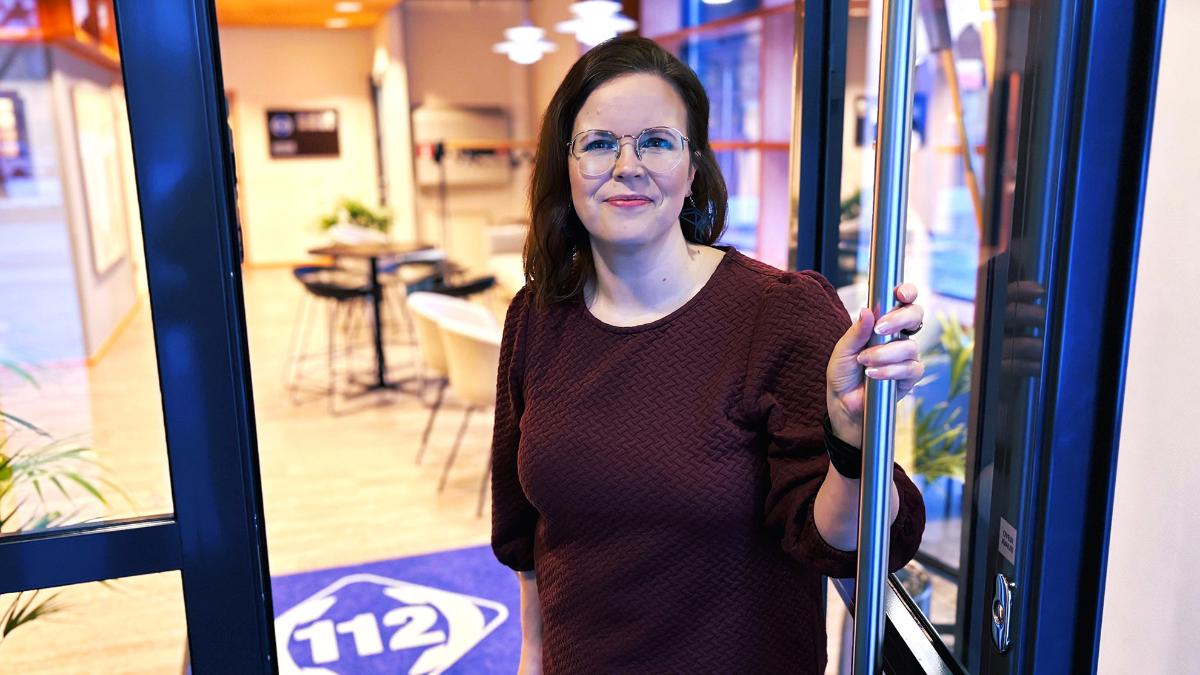
Paula has been working for the Emergency Response Centre Agency for ten years: first as a communications specialist for nine years and then as a wellbeing at work specialist from the start of 2024. By looking after staff wellbeing, she feels that she is doing meaningful work and is able to indirectly contribute to the safety of Finland as a whole.
According to Paula, after general upper secondary school, she wanted to see the world and left for a year to do volunteer work in England. In England, she served as a journalist for a security magazine called ‘Neighbourhood Watch’.
“The magazine supported the activities and safety of the local community. Volunteers from a charitable organisation monitored the neighbourhood, cooperated with the police and aimed to improve the safety in the area. That job as a journalist was the start of my career in communications, and it also marked the start of safety and security as a thread running through my career – in addition to communications and psychology,” Paula says.
For Paula, writing, working creatively and developing new things have always come naturally. After her year in England, she decided to apply to Kymenlaakso University of Applied Sciences to study organisational communication and public relations. Even though Paula applied for a communications programme, she was also interested in psychology. However, the time did not seem right to apply for a psychology programme, so she put the idea on the back burner.
During her studies, Paula worked summer jobs in her own field, and after graduating in 2004, she was immediately hired for an organisational communications role at the Rauma shipyard. She advanced rapidly in her career in the shipbuilding industry. Most recently, she worked as the head of HR communications at three shipyards.
“I am grateful for those years. They taught me important lessons on occupational wellbeing and safety, management, employer image development and the importance of pursuing common goals. I have been able to put all those lessons to use at the Emergency Response Centre Agency. I also completed a Specialist Vocational Qualification in Management on the side,” Paula says.
Paula left the shipbuilding industry to work as a communications specialist at the Emergency Response Centre Agency in 2014. She quickly discovered that her work at the Agencyallowed her to engage in something that continues to motivate her to this day, namely development.
“As far as my working methods go, I am a type of developer. I have my feet firmly on the ground, but I look at things very extensively and in the long term, constantly finding new ideas and opportunities and also realising them,” Paula says.
She has now worked at the Emergency Response Centre Agency for 10 years, and during that time, she has been able to develop many aspects of the Agency’s working culture. Paula has, among other things, established a committee for initiatives, started work on organisational culture and employer image development, been involved in creating and training work community skills and started cooperation with the Emergency Services College with regard to recruitment communications, the effects of which can be seen in the increase in the number of applicants for ERC Operator training.
Employer facilitates continuous development of skills
Alongside working, Paula also fulfilled her dream of studying psychology and is about to graduate with a Master's Degree in Administrative Sciences from the University of Lapland. Her studies have focused on management psychology, and the topic of her Master’s thesis has to do with employee experience and the development of organisations’ abilities to retain employees.
According to Paula, communications and occupational psychology are very closely interlinked, and skills in both areas are mutually supportive.
“Both communications and occupational psychology are about understanding and supporting the thinking and activities of people or the working community. Both are also related in some way to influencing, organisational culture and even to developing leadership and supervisory work skills. I find this a very useful area of expertise, which I will get to utilise in my work at the Emergency Response Centre Agency,” Paula says.
In addition to study leave, the Emergency Response Centre Agency also offered opportunities for employees to develop their skills through staff rotation, which Paula decided to make use of in 2023.
“I participated in staff rotation in the training and development services of the Finnish Immigration Service. It was very interesting and useful for all parties to see the activities of an agency operating in a different administrative branch and expand expertise and network cooperation,” she says.
Promoting staff wellbeing
In her current role as a wellbeing at work specialist, Paula focuses on staff wellbeing, coordinating and developing wellbeing at work activities, developing work capacity management, fostering cooperation with occupational health care services, promoting occupational safety and health and supporting knowledge management.
“The work of ERC operators is very demanding and stressful, which calls for special support and investment in wellbeing at work. In recent years, we have put a great deal of effort into the development of work capacity management and peer support management, and the results of these efforts are already clearly visible,” Paula says.
According to Paula, the tasks of a wellbeing at work specialist are extensive, challenging and very interesting.
“When the staff feel well, it is reflected in the quality and productivity of work. In my work, I aim to facilitate, support and develop ERC operators’ wellbeing at work so that they can provide high-quality ERC services. This way, I see myself as indirectly contributing to the security of Finland as a whole as well as access to help for those in distress,” Paula says.
Paula thinks about things far into the future and is involved in the Agency's development of long-term plans and measures to promote wellbeing at work.
“We are currently working on plans for the occupational wellbeing programme for the new strategy period, the preparation of a pulse survey, the HenkilöstöBaro survey and peer support counsellor training, to name a few. As long as my expertise is needed, I can see myself working here in the future,” Paula sums up.


